Storage Options During Your LA Move: Complete Guide
Three weeks ago our crew picked up a 3-bedroom house in Glendale — the family had sold their home, but their new place in Pasadena wouldn't be ready for another six weeks. Everything they owned needed to go somewhere safe in between. That gap between move-out and move-in is one of the most common situations I handle, and it catches people off guard every time. You're already managing the stress of relocating, and now you need a storage plan on top of it.
Here's the reality: roughly 30% of the moves our Green Moving crews handle involve some form of temporary storage. Whether it's a closing date mismatch, a renovation at the new home, or a downsizing transition where decisions take time, storage is often part of the equation. This guide breaks down your options in Los Angeles, what each one costs, how to size your unit correctly, and how to keep your belongings in good shape while they're waiting for you.
When Storage Becomes Part of Your Move
Not every relocation needs storage, but certain situations make it unavoidable. Knowing ahead of time lets you plan rather than scramble.
Closing date gaps are the most common trigger. Your lease ends on the 1st, your new home closes on the 15th — two weeks of belongings with nowhere to go. In the LA market, these mismatches happen on roughly a quarter of residential sales.
Home staging is another driver. Sellers who need to empty a home for showings while still living in the area park their furniture in storage for 1–3 months. Real estate agents across Beverly Hills and Pacific Palisades recommend this regularly because staged homes sell faster and at higher prices.
Renovations at the new address create a different timeline. A family buying a fixer in Echo Park might need 2–4 months of storage while contractors handle the kitchen and bathrooms. Moving everything in before the work is done means dust-covered furniture and potential damage.
Downsizing transitions require time to decide what stays and what goes. A couple moving from a 4-bedroom in Encino to a 2-bedroom in Culver City can't make every decision in a weekend. Storage buys them breathing room to sort through decades of accumulated belongings without the pressure of a moving-day deadline.
Self-Storage vs. Full-Service Storage
Two fundamentally different approaches, each with clear advantages depending on your situation. I've coordinated moves involving both, and the right choice depends on how much labor you want to handle yourself.
Self-storage means you rent a unit at a facility, transport your items there, and load the space yourself. Most facilities offer 24/7 access, month-to-month contracts, and a range of unit sizes. You control the organization, you decide when to visit, and you handle every trip between your home and the facility.
The upside is cost and flexibility. Monthly rates are lower, you can access your unit whenever you need something, and you don't need to schedule appointments. The downside is labor. Loading a 10×15 unit with the contents of a 2-bedroom apartment takes real physical effort — and if your movers are delivering to the facility, that's an extra stop on your moving day that adds time to the clock.
Full-service storage means a moving company — like Green Moving — picks up your items, transports them to a climate-controlled warehouse, stores them, and delivers them to your new address when you're ready. Your belongings go from the old home to storage to the new home without you touching them twice.
The upside is efficiency. Items stay on the truck from your home and go directly into professional storage — no double-handling, no renting a separate vehicle, no loading a unit yourself. The downside is cost and access. Monthly rates run higher, and you'll need to schedule an appointment if you need to retrieve something mid-storage.
For moves with gaps of two weeks or less, full-service storage usually makes more sense because it eliminates an entire logistical step. For longer storage durations where you need regular access — pulling out seasonal clothes, grabbing specific items — self-storage gives you more control.
What Storage Costs in Los Angeles
LA storage pricing varies by neighborhood, unit size, and whether you choose climate control. Here's what our clients typically encounter across the metro area.
Self-storage monthly rates range broadly. A 5×5 unit (closet-sized, good for boxes and small items) runs $80–$150/month. A 5×10 unit (studio apartment's worth) costs $120–$200. A 10×10 unit (contents of a 1-bedroom) runs $180–$300. A 10×15 unit (2-bedroom apartment) costs $250–$400. And a 10×20 unit (3-bedroom house) goes for $300–$500/month. Facilities in West LA, Santa Monica, and Beverly Hills tend toward the top of those ranges. Inland locations — the San Fernando Valley, Glendale, Pasadena — typically run 15–25% less.
Full-service storage generally costs $200–$400/month for a typical household, with pickup and delivery labor included or billed separately. Climate control comes standard at most professional storage warehouses.
The hidden cost to factor in is transportation. With self-storage, you're either paying movers to make an extra stop (adding 30–60 minutes at hourly rates) or renting a truck yourself. At Green Moving's 3-mover weekday rate of $169/hour, a 45-minute storage detour adds roughly $125 to your move. That narrows the price gap between self-storage and full-service significantly.
Need professional moving and storage? Our crew handles it safely — call (949) 266-9445 or get your free quote.
How to Choose the Right Unit Size
Overestimating wastes money. Underestimating means you're cramming boxes and stacking furniture unsafely. Here's the sizing guide our crew uses based on thousands of storage loads.
5×5 (25 sq ft) — Think of a large closet. Fits 15–20 boxes, a few small furniture pieces, and seasonal items. Good for supplemental storage during a move, not a full household.
5×10 (50 sq ft) — Half a standard garage bay. Holds the contents of a studio apartment or a single large room. A couch, a dresser, a mattress set, and 20–30 boxes fit comfortably.
10×10 (100 sq ft) — A standard garage bay. Fits a full 1-bedroom apartment including living room furniture, bedroom set, and kitchen boxes. The most commonly rented size for LA move-related storage.
10×15 (150 sq ft) — Handles a 2-bedroom apartment or a small house. Room for a full living room set, two bedroom sets, dining furniture, and 40–50 boxes.
10×20 (200 sq ft) — A single-car garage. Stores a 3-bedroom house comfortably, including appliances and outdoor furniture if needed.
10×30 (300 sq ft) — Fits a 4-bedroom house with garage items, workshop equipment, and overflow. Most families don't need this size unless they're storing the contents of a large home plus extras.
My recommendation: rent one size up from what you think you need. The extra $30–$50/month buys you an access aisle down the center of the unit and prevents the Tetris-style stacking that damages furniture and makes retrieval impossible.
Climate Control: When You Need It and When You Don't
LA's climate seems mild, but storage units experience conditions your living room never does. A metal unit in the San Fernando Valley can reach 130°F on a summer afternoon. Coastal units in Venice or Manhattan Beach see humidity spikes that inland locations don't.
Always use climate control for: wood furniture and antiques (wood warps, veneers peel), electronics and computers (heat damages circuits and screens), photographs, albums, and important documents (humidity causes sticking and mold), musical instruments (especially pianos, guitars, and string instruments), leather furniture and goods (dries out and cracks), and wine collections (obvious temperature sensitivity).
Standard units work fine for: metal tools and equipment, plastic storage bins with non-sensitive contents, sporting goods and outdoor gear, and seasonal decorations in sealed containers.
For storage durations under one month during mild weather (October–April), the risk to most items is low even without climate control. For anything beyond a month — or during summer — climate control is worth the 20–30% price premium. I've seen a client's antique dining table warp beyond repair after just six weeks in a non-climate unit in July. That table was worth $4,000. The climate control upgrade would have cost $60.
Protecting Your Belongings in Storage
How you pack and load your unit matters more than which facility you choose. Our crews follow specific protocols for storage loads, and you should too.
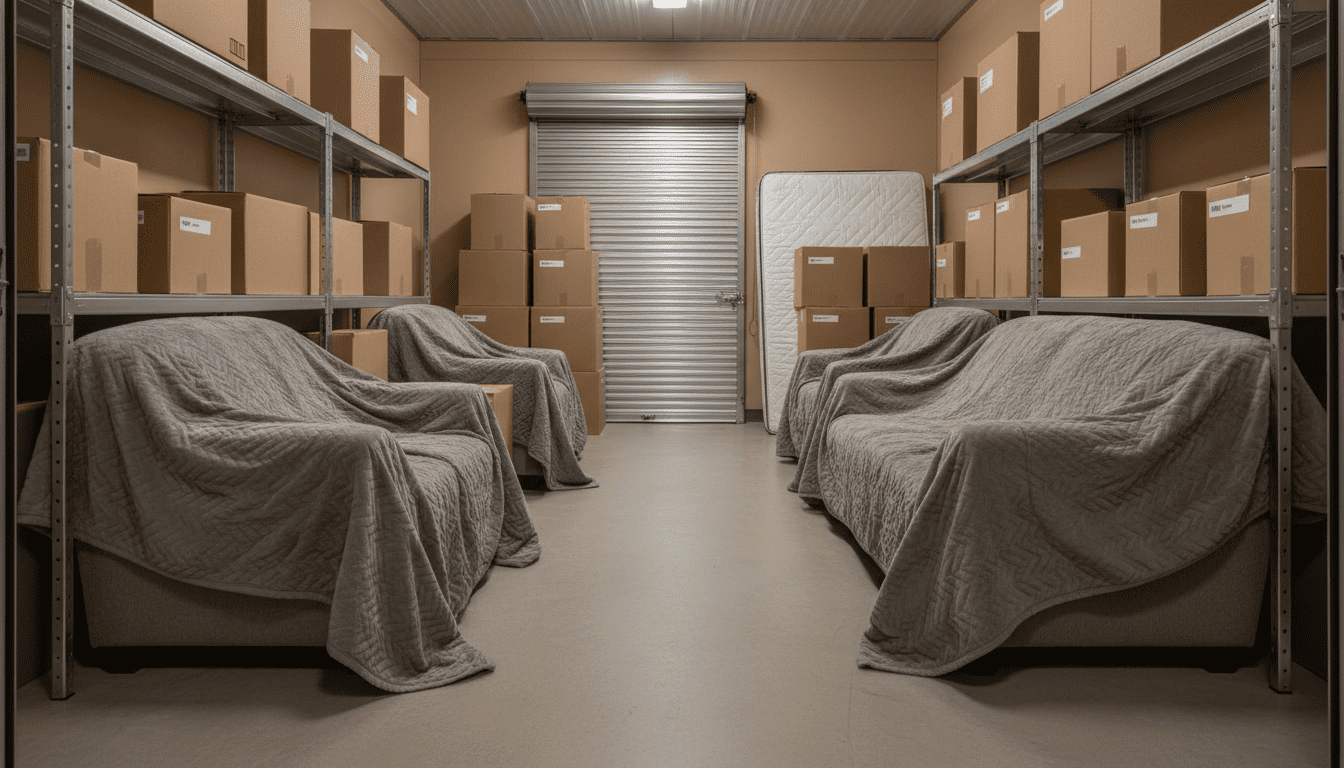
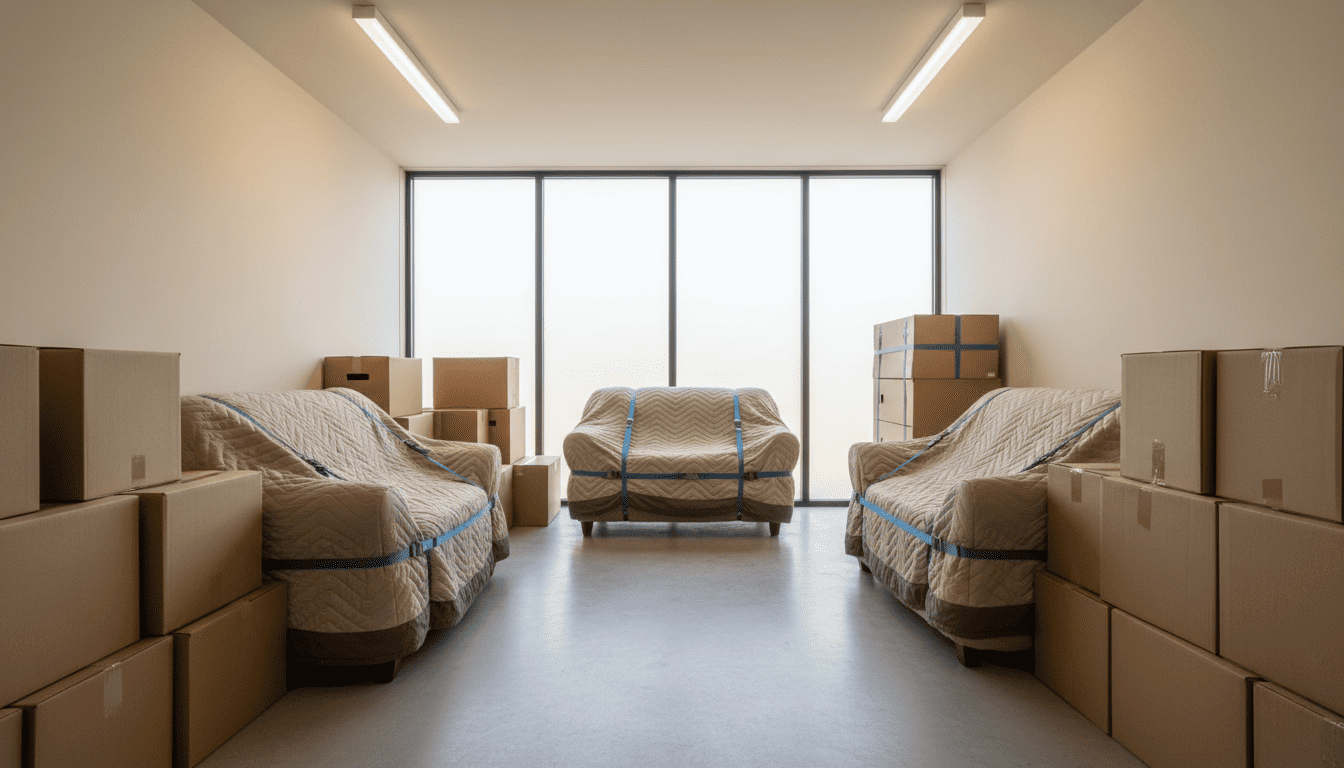
Wrap furniture in moving blankets, not plastic. This is the mistake I correct most often. Plastic wrap seals in moisture and creates conditions for mold growth, even in climate-controlled units. Moving blankets protect surfaces while allowing air circulation. If you don't have blankets, heavy cotton sheets work as an alternative.
Use uniform box sizes for stable stacking. Mixed sizes create unstable towers that topple and crush contents. Medium boxes (3 cu ft, $5 each) and large boxes (4.5 cu ft, $6 each) from our packing supplies stack cleanly and hold weight. Place heavier boxes on the bottom, lighter ones on top.
Create an access aisle. Load your unit with a clear path down the center so you can reach items in the back without unloading the entire space. This takes slightly more room but saves enormous frustration when you need to retrieve something.
Stand mattresses vertically. Laying a mattress flat under stacked boxes compresses the springs permanently. Stand it upright against a side wall, inside a mattress bag to prevent dust and scratches.
Keep an inventory list outside the unit. Photograph the contents of each box before sealing it, or write a numbered inventory. Store the list in your phone or email — not inside the storage unit itself. When you need to find something specific three weeks later, the list tells you exactly which box to open.
Coordinating Storage with Your Moving Day
The logistics of a storage-involved move require more planning than a straight point-A-to-point-B relocation. Here's how to handle it depending on your situation.
Same-day storage drop. If part of your load goes to storage and part goes to your new home, the crew loads storage-bound items first (they come off the truck first at the facility) and home-bound items last (they come off last at the destination). Communicate clearly which items go where — our color-coding system works well here. Read our guide on labeling boxes by room for the full method.
Separate storage day. For larger homes or complex moves, dedicating one day to storage and another to the local move reduces pressure and prevents mistakes. It costs an additional day of labor, but the organization pays off — especially for 4-bedroom homes or larger.
Retrieval timing. When your new home is ready, schedule the storage-to-home delivery in advance. Don't wait until closing day to call — book the crew the moment you have a confirmed date. Peak-season retrieval requests can take a week or more to schedule.
Frequently Asked Questions
How long do most people store belongings during a move?
Based on our data, the average storage duration for move-related situations is 4–6 weeks. Closing date gaps typically run 2–4 weeks. Home staging averages 6–10 weeks. Renovation-related storage can extend to 3–6 months depending on the project scope.
Can movers load my storage unit on the same day as my move?
Yes. Most local moving companies can add a storage stop to your route. At Green Moving, we coordinate multi-stop moves regularly — the key is telling us during the quote process so we plan the loading order correctly. Expect the storage stop to add 30–60 minutes to your move.
Is it cheaper to rent my own unit or use a moving company's storage?
Self-storage has lower monthly rates, but factor in the transportation cost. If your movers charge $169/hour for a 3-person crew and the storage detour adds 45 minutes, that's roughly $125 in labor on top of the unit rental. For short-term storage under 6 weeks, full-service storage often costs about the same once you account for transportation.
What shouldn't I put in a storage unit?
Perishable food, flammable liquids (gasoline, propane, paint thinner), live plants, and anything damp or wet. Most facilities also prohibit firearms and hazardous materials. Important documents — passports, birth certificates, financial records — should stay with you, not in storage, regardless of security level.
Does Green Moving offer storage as part of the move?
Yes. We handle full-service storage with pickup, climate-controlled warehousing, and delivery to your new address on your schedule. It's a single booking with one crew managing everything — no separate facility contracts or self-loading required. Call us or visit our pricing page for a combined moving and storage estimate.
Get Started
Storage doesn't need to be a separate headache stacked on top of your move. The right plan — the right unit size, the right protection, the right coordination with your moving crew — turns a logistical gap into a non-issue.
Schedule Your Free Consultation:
- Call: (949) 266-9445
- Email: sales@greenmovingla.com
- Online: greenmovingla.com/contacts
Green Moving — Licensed (CAL-T 201327) & Insured. 1% of every move supports California environmental causes.